Table of Contents
Introduction
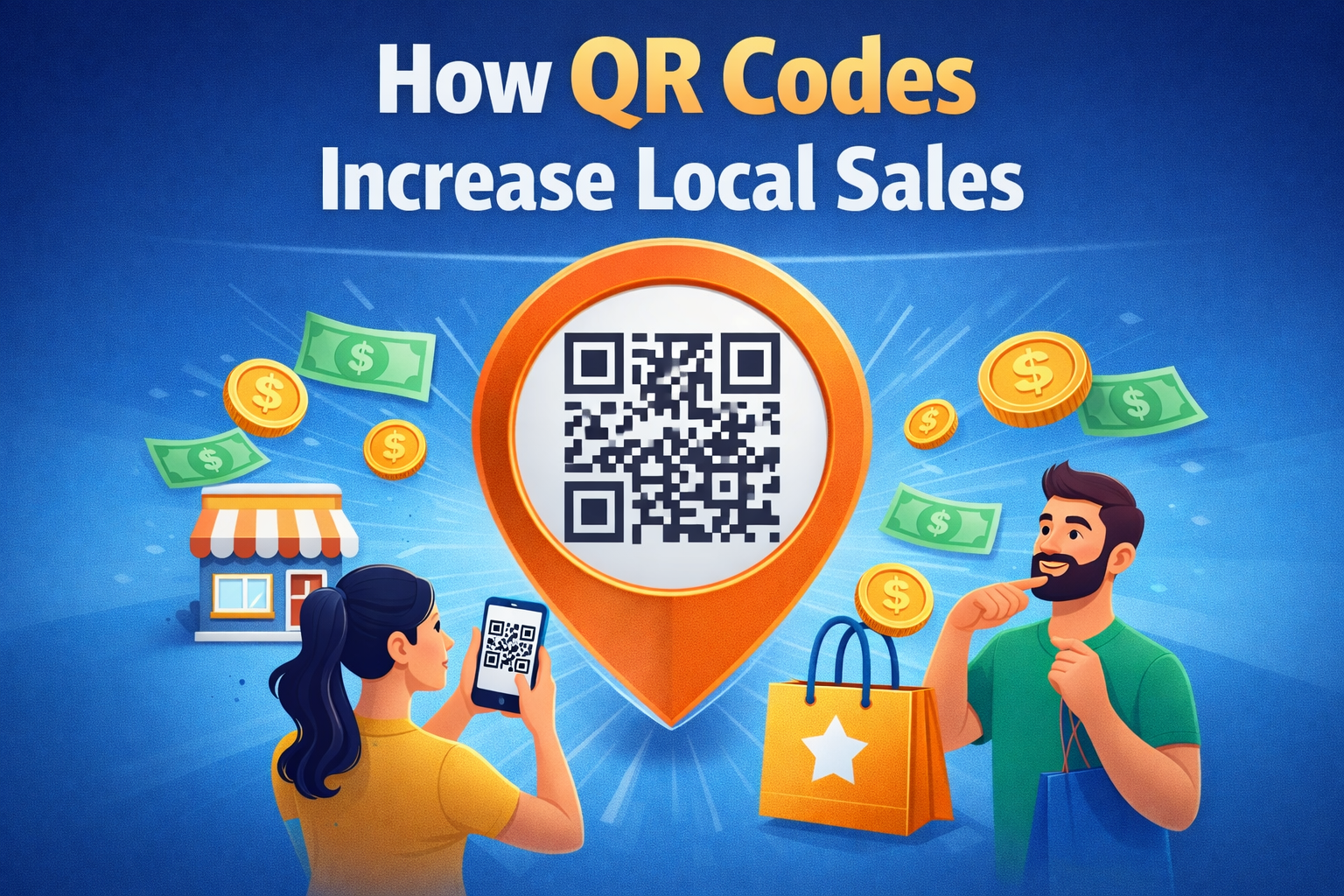
Local businesses across the United States are facing a familiar challenge: attracting nearby customers in an increasingly digital world. Traditional flyers, posters, and storefront signage still matter—but they often fail to connect offline attention with online action. That gap is where QR Codes for Local Sales create measurable impact.
When used strategically, QR codes turn physical touchpoints into direct digital pathways. They help small business owners capture leads, drive in-store visits, promote limited-time offers, and track campaign performance in real time. The key is not just generating a code—but integrating it into a smart local marketing strategy.
This guide explains how QR codes increase revenue locally and how to implement them effectively.
Why QR Codes for Local Sales Work
Consumers are already conditioned to scan.
Restaurant menus, event tickets, product packaging, and payment systems rely on QR technology. Most smartphones now scan codes instantly without a separate app, removing friction from the customer journey.
1. They Bridge Offline and Online Marketing
A printed sign alone cannot track engagement. A QR code can.
By connecting:
- Storefront posters to a coupon page
- Direct mail flyers to an exclusive landing page
- Window decals to Google reviews
You create a measurable funnel.
This is why QR Codes for Local Sales outperform static advertisements—they transform passive views into active interactions.
2. They Support Immediate Action
Impulse decisions drive local revenue.
A customer walking past your store may hesitate. But if a sign says:
“Scan for 15% Off Today Only”
The action becomes immediate. There is no need to type a URL or search manually.
3. They Enable Mobile Customer Engagement
Mobile usage dominates local discovery. Customers search, compare, and review businesses from their phones.
QR codes align perfectly with mobile customer engagement because they:
- Deliver instant access to offers
- Collect email sign-ups
- Open maps for directions
- Launch SMS promotions
How to Use QR Codes for Local Sales Effectively
Generating a QR code takes seconds. Driving sales requires strategy.
Step 1: Define a Clear Objective
Before creating anything, ask:
- Do you want to increase foot traffic?
- Capture email subscribers?
- Promote a limited-time offer?
- Collect customer reviews?
Your objective determines the destination link.
For example:
- A salon may link to a “First Visit Discount” page.
- A coffee shop may link to a loyalty program sign-up.
Clear goals make QR Codes for Local Sales measurable.
Step 2: Create a Dedicated Landing Page
Avoid linking to your homepage.
Instead, build a focused landing page that includes:
- A strong headline
- One clear offer
- A visible call-to-action
- Mobile-optimized design
When customers scan, they should immediately understand what to do next.
Step 3: Add an Incentive
People scan when there is value.
Effective incentives include:
- 10–20% discount
- Free add-on service
- Entry into a giveaway
- Early access to a promotion
Incentives dramatically increase scan rates and help convert engagement into revenue.
Step 4: Place QR Codes Strategically
Location matters more than design.
High-performing placements include:
- Storefront windows
- Checkout counters
- Packaging inserts
- Event booths
- Local partnership locations
A gym, for example, might partner with a nearby smoothie bar—each displaying QR codes that cross-promote offers.
Step 5: Track and Optimize
Modern QR code marketing platforms provide scan analytics.
Track:
- Number of scans
- Time of day
- Device type
- Conversion rate
If one placement generates significantly more scans, replicate that model.
Real-World Examples of Local Revenue Growth
Example 1: Neighborhood Restaurant
A family-owned restaurant placed QR codes on table tents linking to a “Join Our VIP Club” page.
Offer: Free appetizer on the next visit.
Results over 60 days:
- 480 new email subscribers
- 22% return visit rate
- Increased weekday traffic
This is a textbook use of QR Codes for Local Sales—combining loyalty building with measurable ROI.
Example 2: Retail Boutique
A boutique printed QR codes on shopping bags.
Destination: A referral program offering $10 store credit.
Customers shared the link digitally, expanding reach beyond in-store shoppers.
Outcome:
- 17% referral participation
- Noticeable increase in repeat purchases
QR Code Marketing vs. Traditional Print Promotions
| Feature | Traditional Print | QR Code Marketing |
|---|---|---|
| Trackable Data | No | Yes |
| Instant Mobile Access | No | Yes |
| Update Offer Without Reprinting | No | Yes (dynamic link) |
| Lead Capture | Limited | Built-in |
Traditional print raises awareness. QR codes convert that awareness into action.
For small business promotions, this difference is critical.
Advanced Strategies to Increase Foot Traffic
Once basic implementation works, scale strategically.
1. Geo-Targeted Campaigns
Place QR codes in high-traffic nearby locations:
- Coffee shops
- Community boards
- Apartment complexes
Track which neighborhood drives the most scans.
2. Limited-Time Countdown Offers
Add urgency:
“Scan Before 6 PM for Today’s Flash Deal.”
Time-based incentives boost immediate in-store visits.
3. Google Review Boosting
Positive reviews increase local search visibility.
Place a QR code near checkout linking directly to your Google review page. Offer a small incentive such as entry into a monthly drawing.
This enhances credibility while strengthening your local marketing strategy.
Common Mistakes to Avoid
Even simple campaigns can fail without proper execution.
Avoid these errors:
- Linking to a slow-loading website
- Using low-resolution codes that won’t scan
- Placing codes where lighting is poor
- Forgetting to include a call-to-action near the code
- Failing to test before printing
Remember: QR Codes for Local Sales succeed when the customer journey is frictionless.
Measuring ROI from QR Campaigns
Revenue impact should be quantified.
Key performance indicators include:
- Scan-to-conversion rate
- Cost per acquisition
- Increase in repeat customers
- Growth in email subscribers
- Direct sales from promotion codes
If a campaign costs $150 in print materials but generates $2,000 in tracked sales, the return is clear.
Data transforms QR code marketing from experimental to strategic.
Why Small Businesses Should Act Now
Consumer comfort with scanning continues to grow. Younger demographics expect interactive physical marketing.
Early adopters in competitive local markets gain an advantage by:
- Capturing digital leads from walk-in traffic
- Building owned marketing lists
- Increasing lifetime customer value
QR Codes for Local Sales are not a trend—they are a practical tool for modern local growth.
Conclusion
Driving consistent local revenue requires more than visibility—it requires action. QR Codes for Local Sales provide a direct, trackable path from physical presence to measurable conversion.
By defining clear goals, offering meaningful incentives, optimizing placement, and tracking results, small business owners can transform simple printed materials into powerful sales drivers.
If you are looking to strengthen your local marketing strategy and increase foot traffic without increasing ad spend, start testing QR codes in one focused campaign. Measure the results, refine the approach, and scale what works. The opportunity to connect offline attention with digital engagement is already in your customers’ hands.
Get Involved
Explore our tools, give feedback, or contact us anytime — we’re here to help.
Explore More Useful Resources: